
The five Klaviyo flows every eCommerce brand needs in 2026 are the welcome series, abandoned cart, browse abandonment, post-purchase and winback. Together they often generate 30 to 40% of a brand’s email revenue from a small fraction of total sends, because they reach people at the moment of highest intent instead of on a schedule.
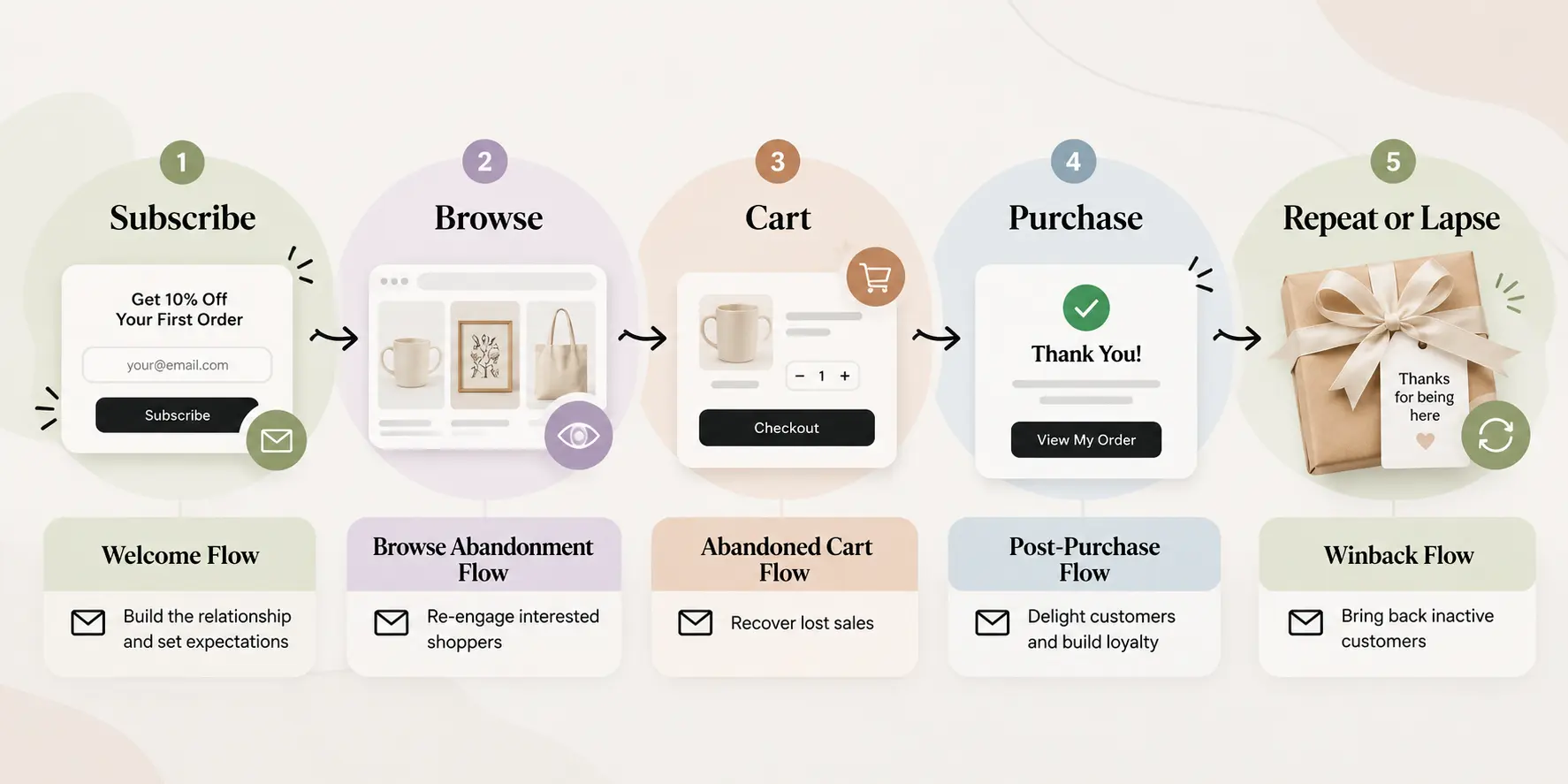
You don’t need twenty flows to get most of the value Klaviyo can offer. You need these five, built correctly, in the right order, with the right triggers and timing. This guide covers what each flow does, the trigger and email-by-email timing, the metric to watch for each one, the build order if you’re starting from zero, and the mistakes that quietly wreck flows that look finished but aren’t. If you’d rather have them built and tuned for you, see my Klaviyo email marketing service.
Key takeaways
- The 5 core flows: welcome series, abandoned cart, browse abandonment, post-purchase and winback.
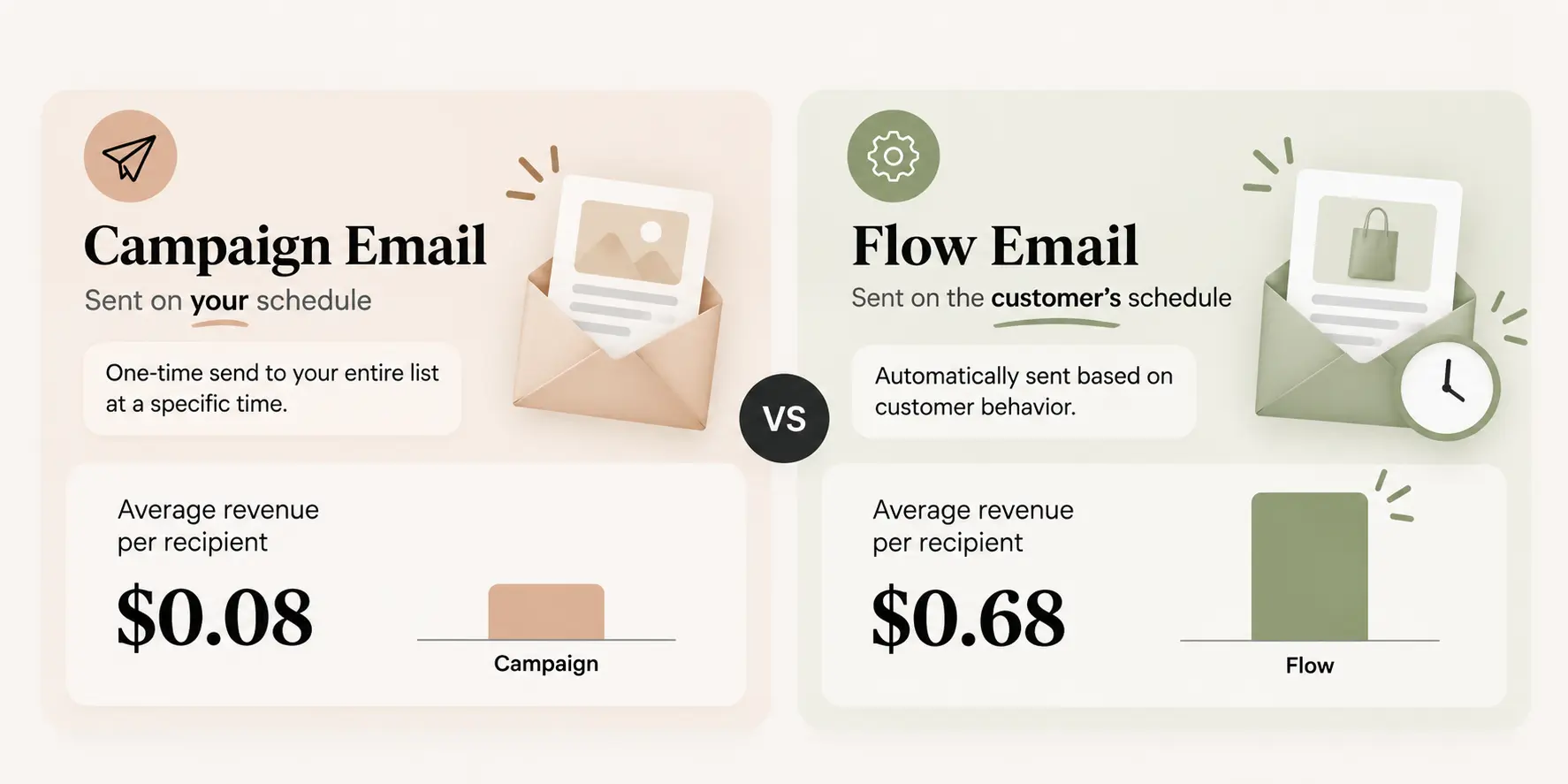
- Why they matter: flows send on intent-triggered timing, not broadcast timing, so revenue per recipient is usually far higher than campaign email.
- Build order: welcome, abandoned cart, browse abandonment, post-purchase, winback. This follows the customer journey and revenue impact.
- Cart vs. checkout matters: abandoned cart (left before checkout) and abandoned checkout (started checkout, didn’t finish) are different events with different intent levels. Many guides blur them.
- The real risk isn’t missing flows, it’s stale ones: generic copy, outdated offers and flows nobody has reviewed in 6+ months underperform even when they’re technically live.
What are Klaviyo flows, and why do they outperform campaigns?
A Klaviyo flow is an automated email or SMS sequence triggered by something a specific customer does: subscribing, viewing a product, abandoning a cart, placing an order or going quiet. Instead of you deciding when to hit send, the customer’s own behavior decides it. Klaviyo describes flows as automation based on events, profile data and timing logic.
That’s the mechanical reason flows outperform one-off campaigns. A campaign reaches everyone at the same moment regardless of intent. A flow reaches one person at their moment of highest intent. A welcome email lands the second someone signs up, while curiosity is fresh. A cart recovery email lands while the product is still mentally in the basket. That timing advantage is why flows routinely produce a disproportionate share of email revenue relative to how few messages they represent.
The 5 core Klaviyo flows
1. Welcome series
A strong welcome series does four things: introduces the brand clearly, explains what makes the product genuinely different, delivers or reinforces the welcome incentive, and moves the subscriber toward a first purchase. Usually that means spotlighting bestsellers or answering the most common first-purchase objection (fit, ingredients, shipping cost, return policy).
A practical structure:
- Immediately: deliver the incentive, a brief brand story and a clear CTA.
- Day 2: social proof such as reviews, UGC and press mentions.
- Day 4: education. Teach something genuinely useful about the product category, not just buy now.
- Day 6 to 8: urgency on the incentive if unredeemed, plus a bestseller spotlight.
Add a conditional split after the first email so anyone who purchases exits the discount-focused messaging and moves into the post-purchase flow instead. There’s no reason to keep offering a discount to someone who already converted.
If the welcome flow is weak or generic, a large share of top-of-funnel intent gets wasted on low-converting content. It’s usually the single highest-leverage flow to get right first.
2. Abandoned cart (and why it’s different from abandoned checkout)
Cart abandonment is one of the largest recoverable-revenue opportunities in eCommerce. Nearly 70% of online shopping carts are abandoned before purchase, according to the Baymard Institute. That single stat is why this flow consistently ranks as a must-have.
It’s worth being precise about a distinction most guides blur: abandoned cart and abandoned checkout are not always the same event. In Klaviyo and Shopify terms, a cart abandonment can be triggered by Added to Cart activity with no checkout started at all, while checkout abandonment is triggered by Started Checkout, meaning the shopper entered contact or payment information and still didn’t finish. Checkout abandoners are closer to the sale and usually need less persuasion and more friction removal (a broken coupon field, unexpected shipping cost, a payment error). Some brands merge the two into one flow. Splitting them typically produces more relevant messaging because the two audiences have different objections.
A practical 3-email sequence:
- About 1 hour after abandonment: a clean reminder with the exact products left behind and no discount yet.
- About 24 hours: social proof and objection handling (reviews, shipping and returns clarity).
- About 48 hours: a final reminder with a modest incentive if margin allows, and genuine urgency.
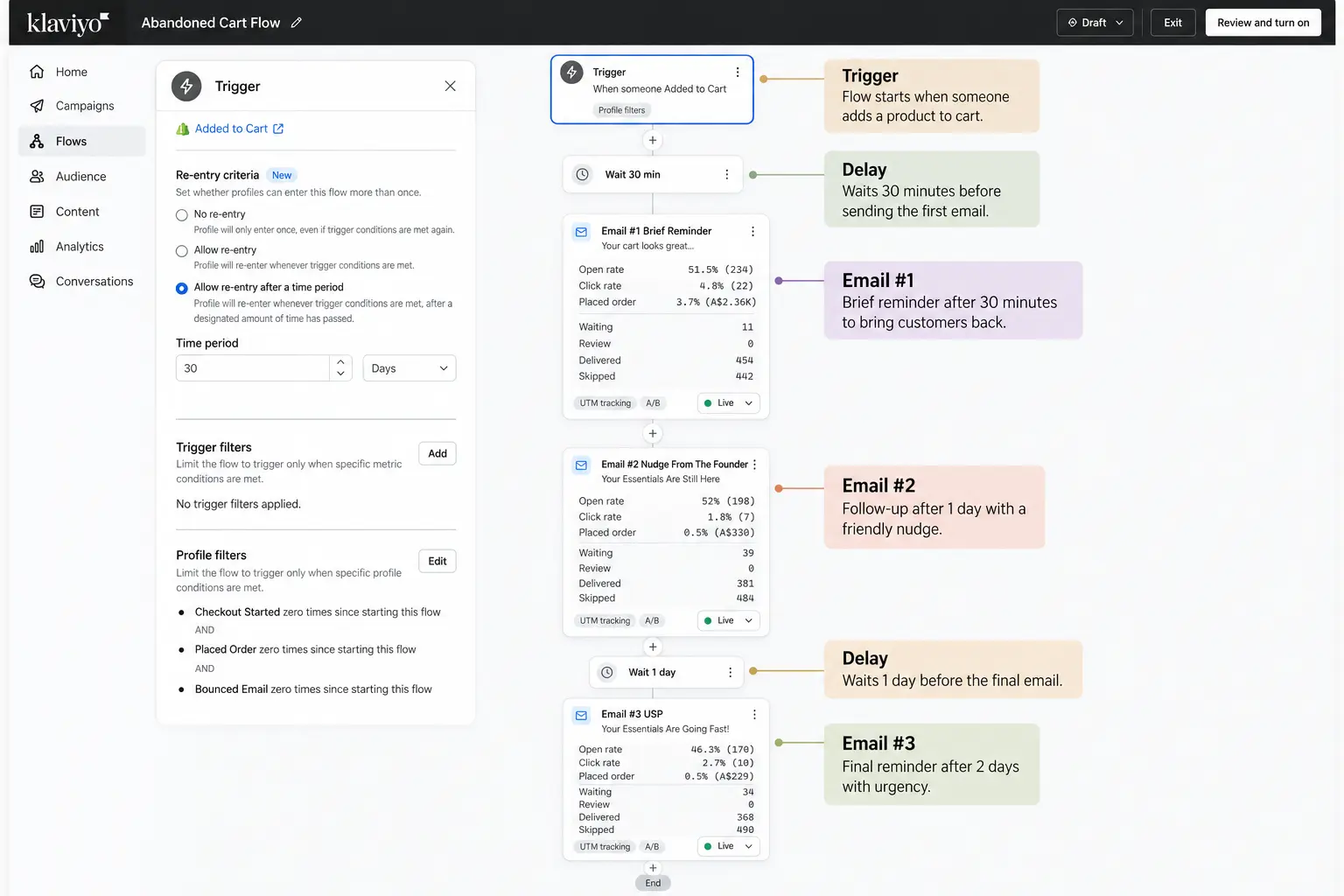
Set the trigger filter to exclude anyone who has completed a purchase since the flow started. Chasing someone for a cart they already checked out from is an easy, avoidable error.
3. Browse abandonment
This flow casts a wider net than cart recovery, with higher volume and lower average intent, so the tone should feel helpful and suggestive rather than urgent. Something like “We noticed you looking at X, here’s X plus two similar options” performs better than recovery-style copy borrowed from the cart flow. Add a frequency cap (roughly once every 7 to 14 days per person) so the same browsing session doesn’t trigger repeated emails.
4. Post-purchase
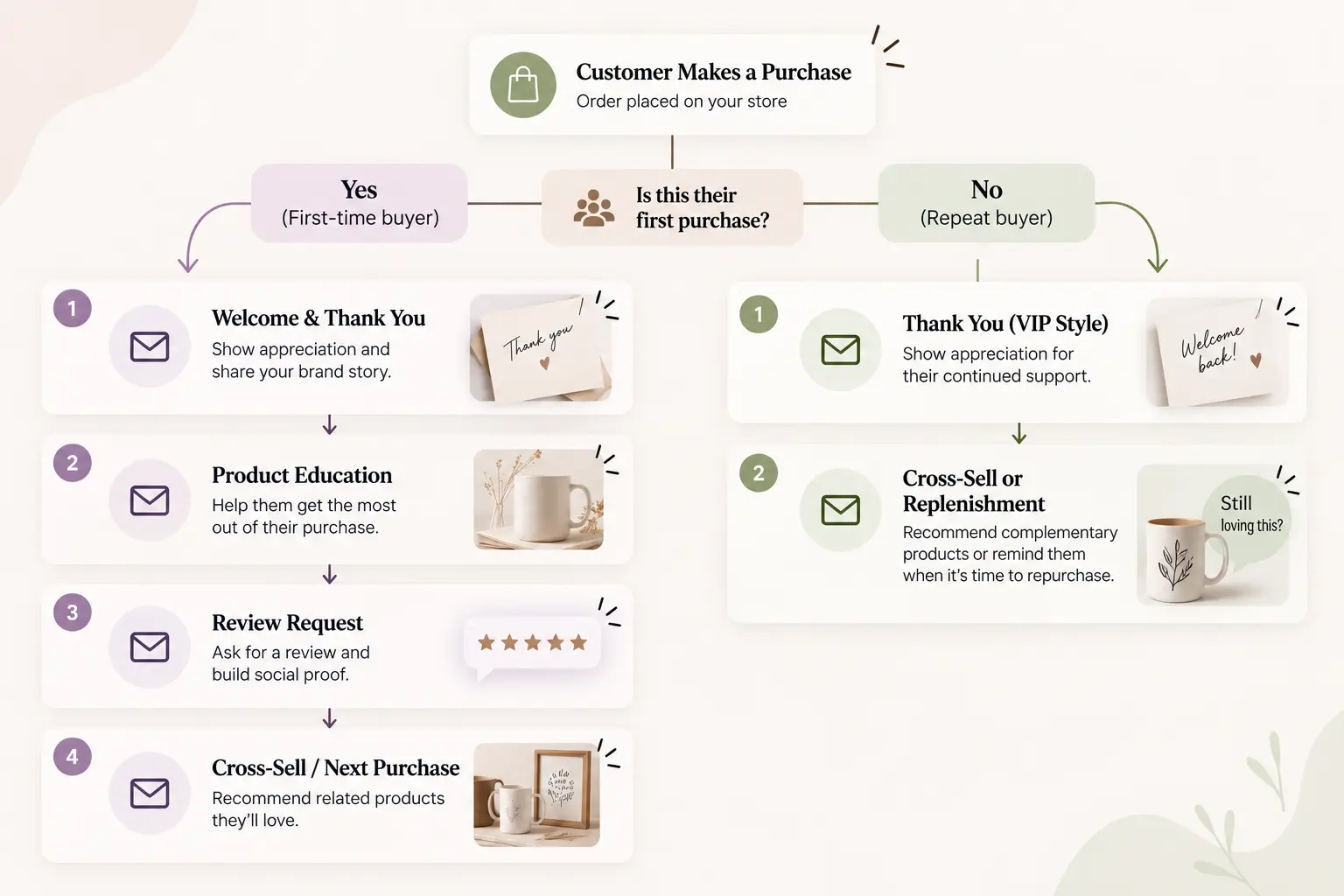
This is the flow most brands under-invest in relative to its impact on repeat-purchase rate. A solid structure includes:
- Immediately: a branded thank-you (not just the Shopify transactional receipt), order details and a genuine reinforcement of the purchase decision.
- After delivery: a review request, timed to land once the customer has actually used the product.
- 1 to 2 weeks later: a cross-sell or replenishment email based on what they bought.
Branch this flow on order count where possible. First-time buyers benefit from more brand story and onboarding. Repeat buyers (order count of 2 or more) can skip straight to cross-sell or replenishment content without re-explaining who you are.
5. Winback (sunset and re-engagement)
A reasonable rule of thumb for timing: trigger at roughly 1.5 times the average time between purchases for your customer base. If customers typically reorder every 50 days, trigger the winback around day 75 to 80.
This flow matters most for brands with a natural repeat-purchase cycle: consumables, replenishable goods, anything with a predictable reorder window. If your category is mostly one-time purchase, winback is still worth having, but it’s reasonably the lowest priority of the five.
A practical structure:
- At the trigger point: a we-miss-you email with a real incentive.
- About 5 days later: a last-chance reminder, plus what’s new since they last engaged.
- About 10 days later: the breakup email. Let them know you’ll stop emailing if there’s no response, with one final link to stay subscribed.
This isn’t just a revenue flow, it’s list hygiene. Sending regularly to a large block of disengaged contacts drags down sender reputation, which quietly suppresses open rates across every other flow, including your welcome series and cart recovery.
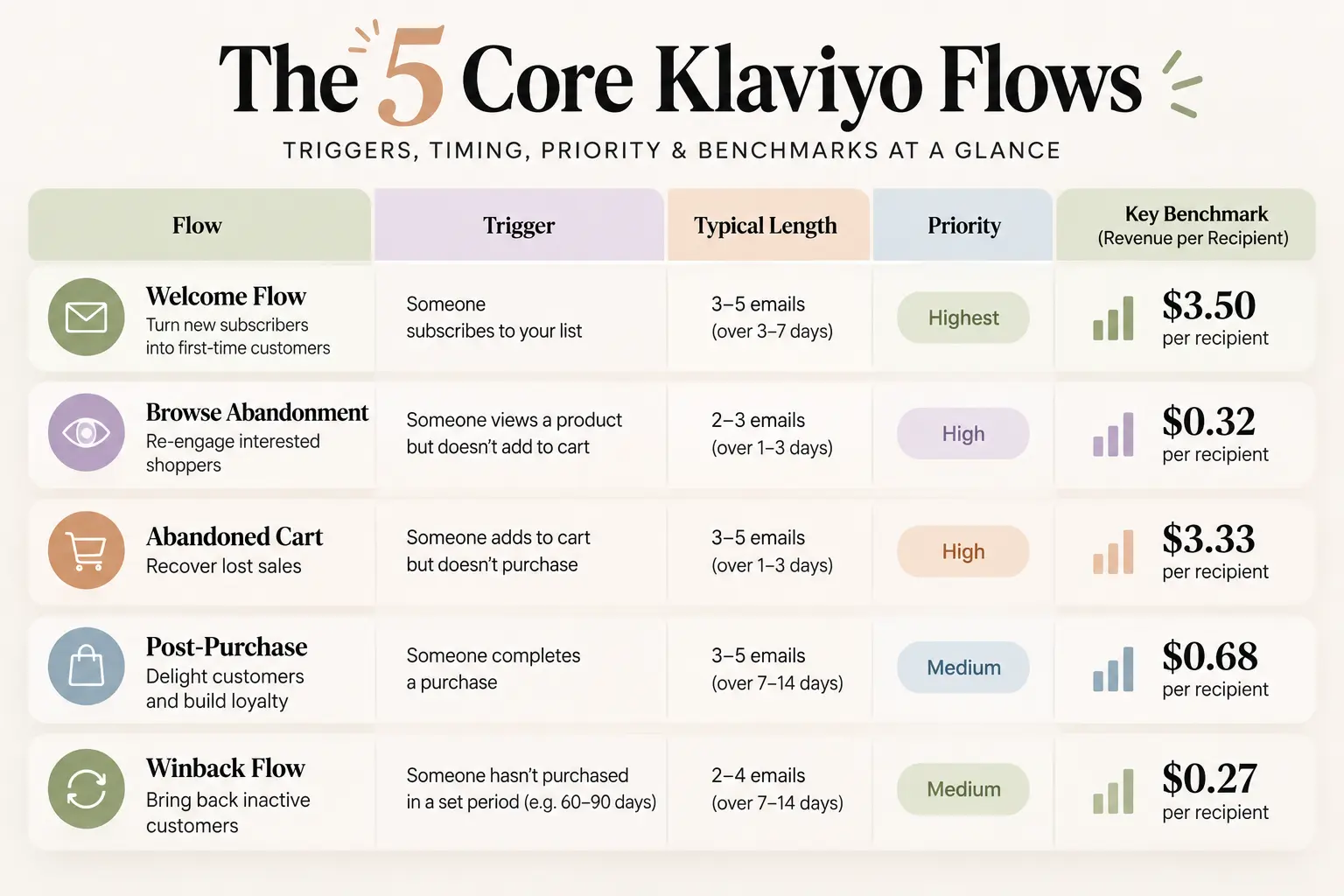
The 5 flows at a glance
| Flow | Trigger | Typical length | Priority | Key benchmark to watch |
|---|---|---|---|---|
| Welcome series | Subscribed to List | 3 to 5 emails / 7 to 10 days | Must-have | First-purchase conversion rate |
| Abandoned cart | Added to Cart (no order) | 2 to 3 emails / 24 to 72 hrs | Must-have | Cart recovery rate |
| Browse abandonment | Viewed Product (no cart or checkout) | 1 to 2 emails / 24 hrs | High | Click-through to product page |
| Post-purchase | Placed Order | 2 to 4 emails / 2 to 3 weeks | High | Repeat purchase rate within 90 days |
| Winback | Inactivity of 1.5x purchase cycle or more | 2 to 3 emails / 2 to 3 weeks | Conditional (repeat-purchase brands) | Reactivation rate and list health |
Build order: what to set up first if you’re starting from scratch
If you’re building Klaviyo from zero, prioritize by business impact, not by how many automations you’re technically capable of launching:
- Welcome series: the highest-intent audience you’ll ever have.
- Abandoned cart: recovers already-demonstrated purchase intent.
- Browse abandonment: a wider funnel, and cheaper to add once the cart flow is live.
- Post-purchase: compounds every dollar you’ve already spent acquiring the customer.
- Winback: add it once you have enough purchase-cycle data to time it correctly.
Before building any of the five, confirm the technical foundation is in place. The Klaviyo and Shopify (or other platform) integration should be connected with both read and write access, and the core events (Viewed Product, Added to Cart, Started Checkout, Placed Order) should be firing correctly. Your signup form also needs a real incentive attached, because a welcome flow without an incentive-bearing popup typically converts far below its potential. Tracking across the rest of your stack matters too, see my GA4 and GTM tracking service.
Common mistakes that quietly wreck these flows
Most underperforming Klaviyo accounts don’t have a missing flow problem. They have an execution problem.
- Generic content. Copy that could belong to any brand in the category underperforms regardless of how well the trigger and timing are configured. Specific product differentiation and a real brand voice consistently outperform templated language.
- Stale flows. Offers expire, products get discontinued, creative gets dated and customer objections shift, but the flow keeps running unchanged for months. Review core flows at minimum quarterly. High-volume ones (welcome, cart, post-purchase) benefit from more frequent testing.
- Missing or wrong filters. A cart recovery email sent to someone who already checked out isn’t just wasted spend, it damages trust. Use both trigger filters (who enters the flow) and flow filters (conditions checked before each send) to prevent this.
- Over-segmenting too early. Smaller brands often add complexity, like VIP branches and hyper-granular segments, before the core five flows are even performing well. Two segmentation layers are usually enough early on: product interest (what someone viewed or bought) and zero-party data (what they told you directly via a quiz or preference form).
- No smart-sending discipline. Without a minimum gap between flow emails, customers can get stacked with multiple automated sends in the same day, which reads as spammy regardless of how good any individual email is.
Not sure which of these five flows are leaking revenue in your store?
I audit and build Klaviyo flows for eCommerce brands, with the right triggers, filters and timing so each flow earns its keep.
See Klaviyo Email Marketing →Beyond the core five: what to build next
Once the five foundational flows are live and performing, several conditional flows become worth adding depending on your business model:
- VIP and loyalty flows: valuable with a real tiering system or loyalty program, not a first priority for smaller brands.
- Back-in-stock flows: worth prioritizing if specific SKUs sell out often.
- Replenishment flows: highly relevant for consumable categories (skincare, supplements, pet, food and beverage) with a predictable reorder cycle.
- Subscription lifecycle flows: failed payment recovery, renewal reminders and cancellation-prevention flows become some of the highest-impact automations for subscription or membership businesses specifically.
FAQ: Klaviyo flows for eCommerce
What are the most important Klaviyo flows for eCommerce?
The five most important are welcome series, abandoned cart, browse abandonment, post-purchase and winback. These cover the full core customer journey from first subscription to lapsed buyer and typically account for the majority of a brand’s automated email revenue.
Which Klaviyo flow should I build first?
The welcome series, because it reaches subscribers at their highest point of interest. Abandoned cart is almost always the second priority since it targets people who already demonstrated purchase intent.
Is abandoned cart the same as abandoned checkout in Klaviyo?
Not necessarily. Abandoned cart typically refers to items added to cart with no checkout started. Abandoned checkout refers specifically to a shopper who began checkout (often entering contact or payment details) and didn’t complete it. Checkout abandoners are closer to purchasing and often need less persuasion and more friction removal.
How many emails should a Klaviyo welcome series have?
There’s no universal number, but 3 to 5 emails over 7 to 10 days is a common, effective range. The right length depends on product complexity and how much education a customer needs before buying.
When should I trigger a Klaviyo winback flow?
A practical rule is roughly 1.5 times your average time between purchases. If customers typically reorder every 50 days, trigger the winback around day 75 to 80 of inactivity.
Do all eCommerce brands need a winback flow?
Not equally. It’s most valuable for brands with a clear repeat-purchase cycle, such as consumables and replenishable products. If your category is mostly one-time purchase, post-purchase and cross-sell automations usually matter more than winback.
How often should Klaviyo flows be reviewed or updated?
At minimum quarterly for core flows. High-volume flows (welcome, abandoned cart, post-purchase) benefit from more frequent creative and offer testing, since stale content is one of the most common causes of underperformance.
The bottom line
You don’t need a large Klaviyo flow library to get most of the available revenue. You need these five, built with the right triggers, sensible timing and content that doesn’t read as interchangeable with every other brand’s automation. Get welcome, abandoned cart, browse abandonment, post-purchase and winback live, reviewed on a regular cadence and genuinely specific to your brand. Then expand into VIP, replenishment or subscription flows once the foundation is earning its keep.
Next step: audit your current Klaviyo account against the five flows above. If any are missing, unclear on triggers, or haven’t been touched in six months, that’s the starting point, not a twelfth new automation.
Want these five flows built and tuned for your store?
I set up Klaviyo flows for eCommerce brands end to end, from the technical foundation to the copy and the testing plan. No pitch, no commitment.
Book a Free Strategy Call →Or message me directly on WhatsApp.
Sources and notes
- Baymard Institute, Cart Abandonment Rate Statistics
- Timing windows, email counts and revenue share figures in this guide are working rules of thumb from common practice. Results vary by category, list quality, offer and traffic source, so treat them as starting points and test in your own account.