
ROAS drops when you scale Meta ads because a bigger budget forces Meta to spend faster across colder audiences and weaker placements. CPM and frequency rise first, conversion rate softens, and a large edit can restart the learning phase. To fix it, raise budget 15 to 20% at a time, spread spend across ad sets, and add fresh creative before frequency passes 3.
Key takeaways
- Frequency and CPM move days before ROAS does, so watch them first.
- Three causes drive most drops: audience saturation, a learning phase reset, and a funnel that cannot convert the extra cold traffic.
- Track incremental reach, not only ROAS. Flat reach with rising spend means you are paying to show the same people the same ad.
- Scale in steps of 15 to 20% every 2 to 3 days and let each step settle for 3 to 4 days.
- Keep a separate testing budget and 3 to 5 new creatives ready before fatigue starts.
Why does ROAS drop when you scale Meta ads?
At a small budget, Meta only needs a narrow pool of high intent people to spend your money well. When you raise the budget, the same system has to deliver more impressions in the same window. Delivery opens up to more placements, more audience segments and more of the borderline impressions it skipped before.
In most accounts the damage shows up in the same order:
A learning phase reset can make this worse. Meta states that an ad set typically leaves the learning phase after about 50 optimization events in a 7 day period, and that a significant edit can send it back into learning. Most media buyers treat a budget jump above roughly 20% as the danger zone. That 20% figure is an industry rule of thumb and not a published Meta number, so use it as a guide and check your own account.
| Signal | At a small budget | After a large budget increase | What it means |
|---|---|---|---|
| Audience pool | Narrow and high intent | Wider and colder | Lower purchase intent per impression |
| Placements | Best performers only | More placements, some weaker | Higher CPM and cost per purchase |
| Frequency | About 1.1 to 1.6 | 2 and rising | Repeat views and fatigue |
| Learning phase | Stable delivery | May restart | Unstable costs for several days |
| Funnel load | Warm and retargeting heavy | More cold traffic | Middle and bottom creative must convert it |
How do you diagnose where the ROAS drop is coming from?
Check these four things in Ads Manager before you change anything.
1. Rule out tracking. If purchases fell in Ads Manager but not in your store, fix tracking first. A broken pixel or Conversions API setup looks exactly like a ROAS drop. My GA4 and GTM tracking service covers this.
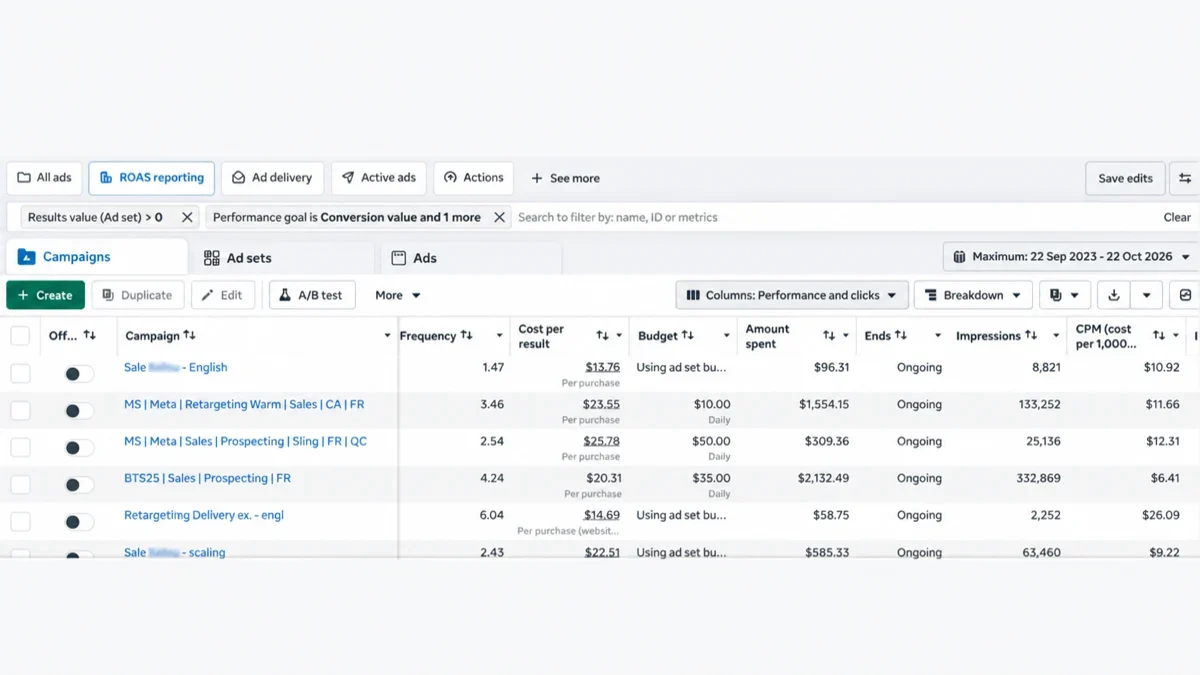
2. Check frequency over a 7 day window. If frequency on your scaling campaign climbs past 3 within a week, more budget will not buy more revenue. Meta is re showing the ad to people it already reached.
| Frequency (7 days) | Reading | What to do |
|---|---|---|
| Up to 1.7 | Mostly fresh reach | Safe to keep scaling in steps |
| 1.8 to 2.9 | Repeat heavy | Add new creative and widen audiences |
| 3.0 and above | Fatigue risk | Refresh creative before adding budget |
3. Check incremental reach. Pull single day reach for two consecutive days, then set the date range to cover both days. The combined number is smaller than the two daily numbers added together. That gap is repeat reach, and what remains is net new reach.
| Metric | Example value |
|---|---|
| Reach on day 1 | 10,000 |
| Reach on day 2 | 10,000 |
| Combined reach, days 1 and 2 | 16,000 |
| Repeat reach (10,000 + 10,000 – 16,000) | 4,000 |
| Net new reach on day 2 (16,000 – 10,000) | 6,000, or 60% of day 2 reach |
If net new reach stays flat or shrinks while spend keeps rising, you are paying more to reach the same people. This usually shows up before ROAS drops, so it is worth checking daily.
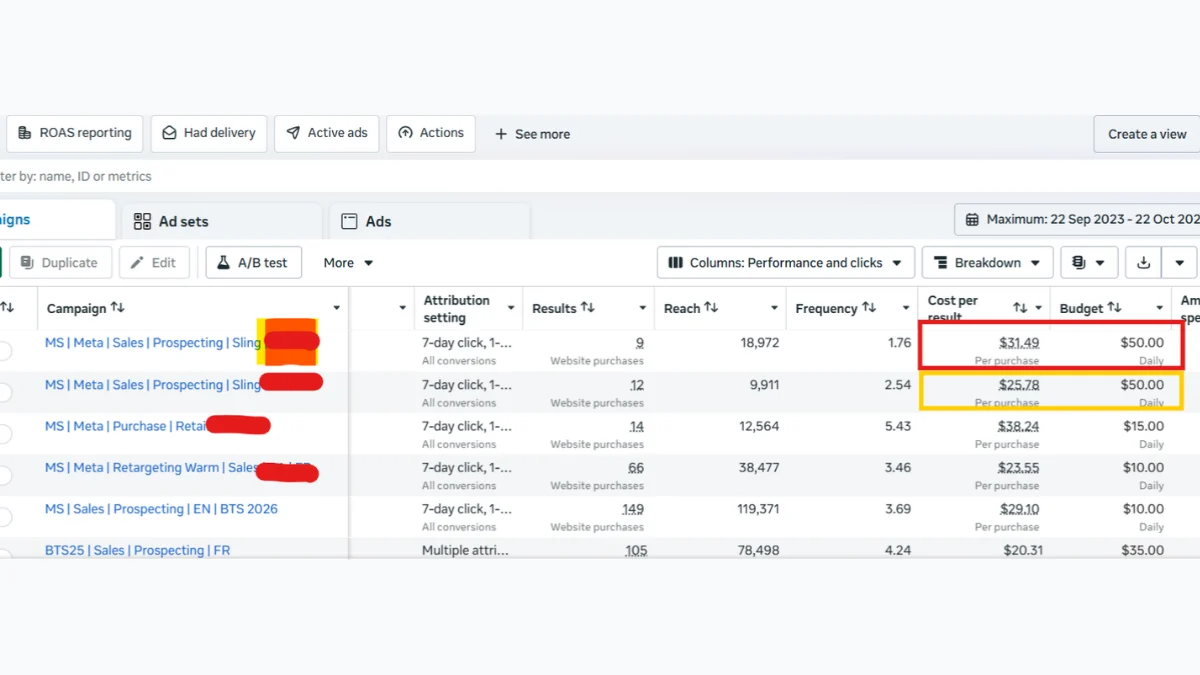
4. Check funnel and creative distribution. Break performance out by new, engaged and existing customers. An account that looks efficient at a small budget often leans on warm and retargeting pools. Scale it and the gap shows. Too little top of funnel creative starves reach. Too little middle and bottom funnel creative wastes the cold traffic that does arrive.
How much should you raise your Meta ads budget at a time?
Raise budget by 15 to 20% every 2 to 3 days, and give the ad set 3 to 4 days to settle after each step. This usually stays under the size of edit that restarts learning, so delivery adjusts instead of resetting.
| Day | Daily budget | Change |
|---|---|---|
| 0 | $100 | Starting point |
| 3 | $120 | +20% |
| 6 | $144 | +20% |
| 9 | $173 | +20% |
| 12 | $207 | +20% |
How do you fix ROAS drops when scaling? 7 steps
- Scale in steps. Move budget up 15 to 20% every 2 to 3 days instead of doubling overnight.
- Scale across ad sets. Duplicate winning ad sets into new audiences, placements or creative angles so fatigue does not pile up in one pool.
- Match funnel supply to demand. Each time you raise top of funnel spend, check that middle and bottom funnel creative can convert the extra cold traffic within a normal purchase window.
- Keep a creative refresh cycle. Have 3 to 5 new variations ready before frequency starts climbing.
- Separate testing from scaling. Run a small steady budget that validates new angles and audiences, so you have proven options when the main campaign tires.
- Let the algorithm settle. Avoid touching budget, audience or creative for 3 to 4 days after a step.
- Consider consolidated budgets at higher spend. Campaign Budget Optimization or Advantage+ setups let Meta spread spend across funnel stages inside one budget pool.
Scaling Meta ads and watching ROAS slip?
This is exactly what I fix for eCommerce brands: rebuilding account structure, creative pipelines, and funnel coverage so ROAS holds as you scale.
Get a Free Meta Ads Audit →| Scaling method | What you do | Best for | Main risk |
|---|---|---|---|
| Vertical | Raise budget on the same ad set in small steps | Healthy ad sets with low frequency | Frequency spikes and learning resets |
| Horizontal | Duplicate winners into new audiences, placements and angles | Steady growth with a creative pipeline | More to manage, needs more creative |
| Consolidated (CBO or Advantage+) | One budget pool across ad sets and funnel stages | Accounts at higher spend | Less control over where spend goes |
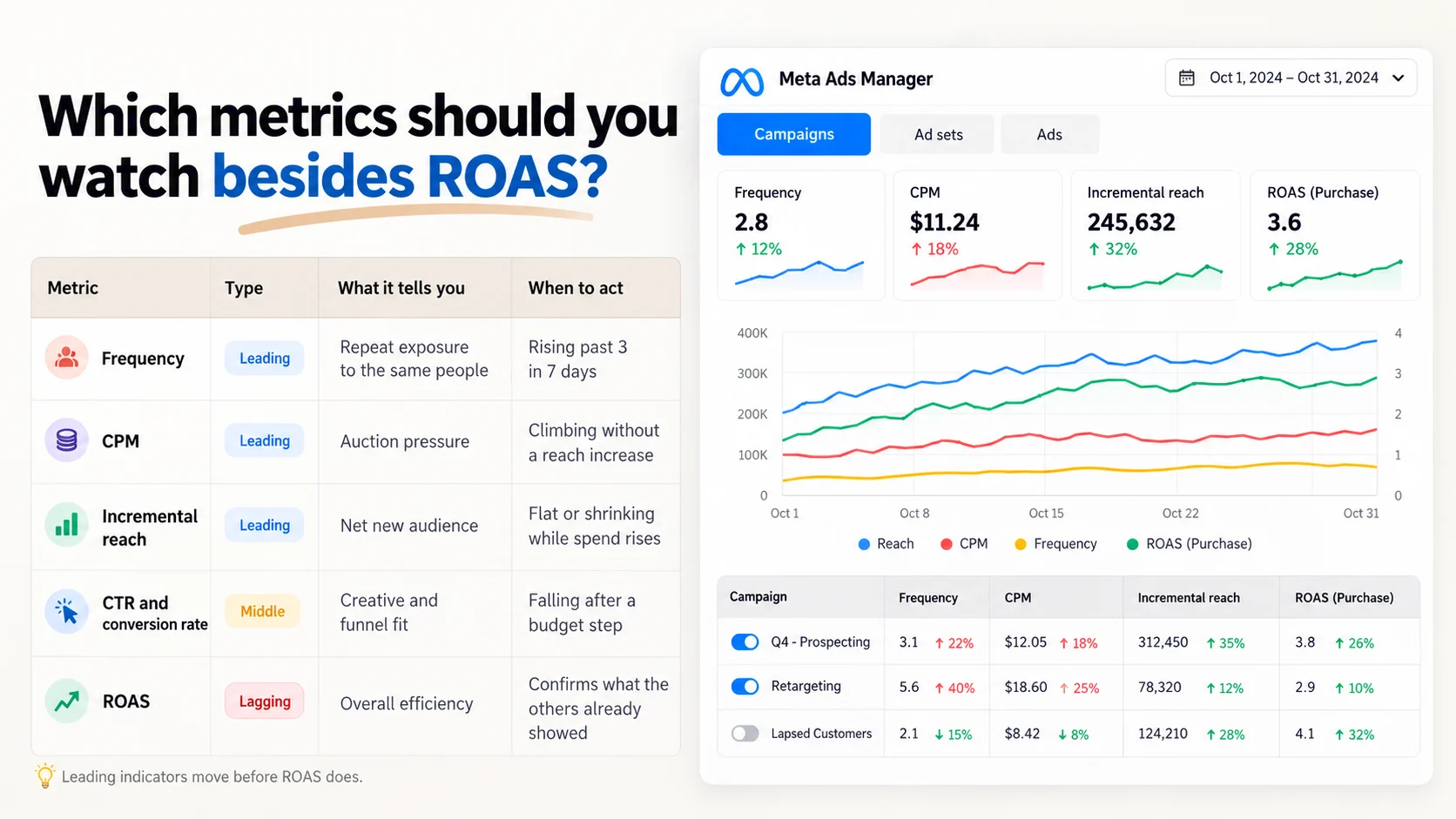
Which metrics should you watch besides ROAS?
| Metric | Type | What it tells you | When to act |
|---|---|---|---|
| Frequency | Leading | Repeat exposure to the same people | Rising past 3 in 7 days |
| CPM | Leading | Auction pressure | Climbing without a reach increase |
| Incremental reach | Leading | Net new audience | Flat or shrinking while spend rises |
| CTR and conversion rate | Middle | Creative and funnel fit | Falling after a budget step |
| ROAS | Lagging | Overall efficiency | Confirms what the others already showed |
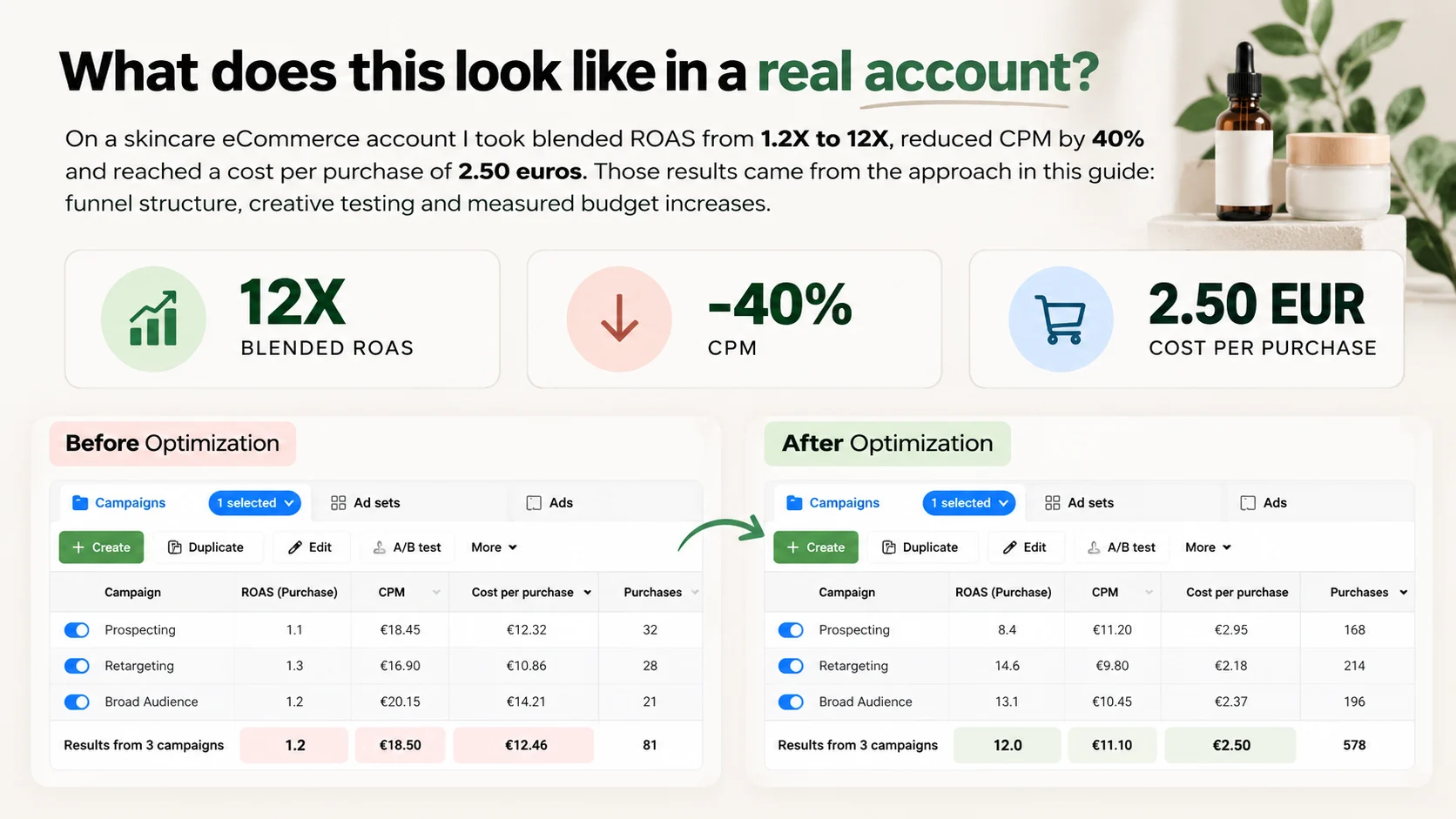
What does this look like in a real account?
On a skincare eCommerce account I took blended ROAS from 1.2X to 12X, reduced CPM by 40% and reached a cost per purchase of 2.50 euros. Those results came from the approach in this guide: funnel structure, creative testing and measured budget increases.
More examples are on my Meta Ads service page, and email flows that lift repeat purchases are covered on my email marketing page.
FAQ: scaling Meta ads and ROAS
Why does ROAS drop as soon as I increase my Meta ads budget?
A bigger budget forces Meta to spend faster, so delivery reaches into colder audiences and less efficient placements. CPM and frequency usually rise first, conversion rate softens, and a large edit can send the ad set back into the learning phase. ROAS is the last number to move.
How much can I increase my Meta ads budget at once?
A common rule of thumb is 15 to 20% every 2 to 3 days. Larger jumps, roughly above 20%, are more likely to count as a significant edit and restart learning. The 20% figure is industry practice and not an official Meta number, so watch your own account.
What frequency is too high when scaling Meta ads?
As a working guide, a frequency above 3 within a 7 day window on a scaling campaign signals fatigue risk. It does not mean you should stop. It means the current creative and audience cannot absorb more budget without fresh ads or wider targeting.
What is incremental reach and how do I calculate it?
Incremental reach is the number of new people you reached today who you had not reached before. In Ads Manager, pull reach for day one, then for days one and two combined. Subtract the day one reach from the combined reach. The result is net new reach for day two.
Should I scale by raising budget or by duplicating ad sets?
Use both in measured amounts. Small budget steps work on healthy ad sets, while duplicating winners into new audiences, placements or creative angles spreads frequency across more people. Putting the whole increase into one ad set concentrates fatigue and auction pressure in one place.
How often should I check frequency and incremental reach?
Check daily during an active scale up and weekly once spend has stabilized. Frequency, CPM and incremental reach usually change days before ROAS does, so they give you time to react.
How long does the Meta learning phase last?
Meta states that an ad set typically exits the learning phase after about 50 optimization events within a 7 day period. The time varies with budget and conversion volume. Significant edits can restart the count, which is why stepwise changes matter.
Does a ROAS drop always mean my ads stopped working?
No. Rule out tracking problems, seasonality, stock or offer changes and attribution shifts first. If those are clean, the drop usually reflects delivery moving into colder audiences, which you can address with structure, creative refresh and slower budget steps.
The bottom line
A ROAS dip after a budget increase is the Meta delivery system doing what it is built to do: spend more, faster, across a wider pool. Accounts that scale well spread the pressure across budget steps, ad sets, funnel stages and time. Watch frequency and incremental reach as your early warning, and treat ROAS as the number that confirms what they already showed.
Want someone to diagnose your account for you?
I audit Meta Ad accounts end to end, covering frequency, incremental reach, funnel balance and creative testing, then hand you a clear roadmap to scale profitably. No pitch, no commitment.
Book a Free Meta Ads Audit →Or message me directly on WhatsApp.
Sources and notes
- Meta Business Help Center: Last significant edit. Describes edits that can send an ad set back into the learning phase.
- The 15 to 20% step size, the 20% reset threshold and the frequency bands are industry rules of thumb and working guidelines from my own accounts. They are not official Meta thresholds.
- Worked examples (incremental reach and the budget ladder) are illustrative numbers.
I’m Waseem, a performance marketer who builds acquisition and retention systems for eCommerce brands. I run Meta Ads, Google Ads, email, and full-funnel growth for brands scaling past their plateau. See how I work →