
To protect ROAS on Black Friday, pull your baseline numbers early, lock your offer and break-even return, ramp budget in 15 to 20% steps through mid-November, freeze structural changes during Black Friday week, and save your biggest budget jumps for Black Friday and Cyber Monday themselves. Watch frequency, CPM and blended MER before you trust ROAS.
Black Friday is the scaling problem from my last post on why ROAS drops when you scale Meta ads, compressed into four weeks and raised to maximum pressure. Everyone increases budget at once, CPMs spike across the entire auction, and accounts that haven’t prepared end up paying peak prices for the same traffic they were getting cheaply in October. The accounts that come out ahead aren’t the ones with the biggest budgets. They’re the ones that ramped on a schedule, froze the right things at the right time, and knew which numbers to check during the chaos instead of staring at ROAS alone.
Black Friday 2026 falls on November 27, with Cyber Monday on November 30. This is a step by step checklist, in order, from now through the first week of December.
Key takeaways
- Pull your baseline numbers (CPM, CPA, frequency, blended MER) before you change anything. You need something to compare against once costs spike.
- Lock your offer and calculate your break-even return early. A deeper discount raises the return each ad dollar has to earn, often by more than people expect.
- Ramp budget in small steps through mid-November and save the big jumps for Black Friday and Cyber Monday themselves.
- Freeze structural changes (targeting, bid strategy, new creative into live ad sets) during Black Friday week. Fix only real problems.
- Watch frequency and CPM as your early warning signs, same as any other scaling period, just compressed into days instead of weeks.
Before you touch budget (now through early November)
1. Pull your baseline numbers
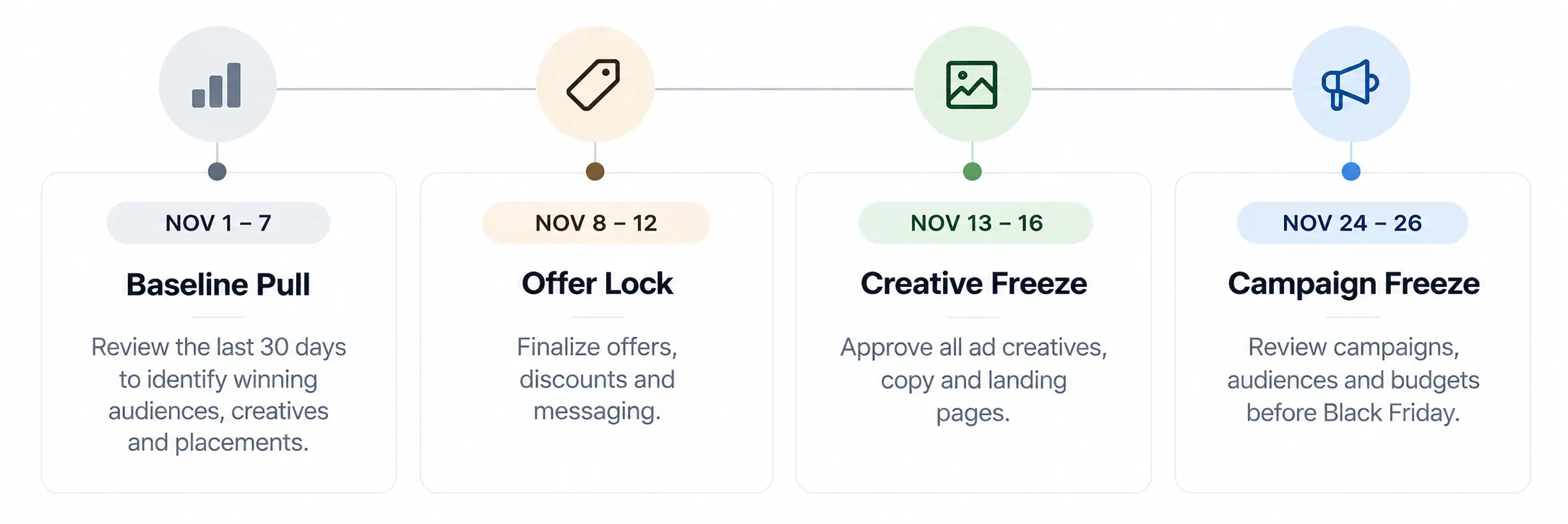
Before you change a single setting, record your current CPM, CPA, frequency and blended MER (total revenue divided by total ad spend across all channels, not just what Meta reports). You’ll need this baseline to know whether a cost increase during Black Friday week is normal seasonal pressure or something actually broken in your account.
2. Consolidate prospecting into fewer, larger ad sets
Scattered ad sets, each collecting a little data individually, struggle to gather enough volume to stay out of the learning phase once competition increases. Merging prospecting into fewer, bigger ad sets in early November gives each one a better shot at staying stable through the ramp.
3. Lock your offer and calculate your break-even return
Pick one headline offer and get the discount finalized before you build anything else around it. Run the math on what return each ad dollar needs to generate at that discount level. A deeper discount can push your required return up substantially, sometimes by 25% or more, which changes how aggressively you can actually afford to bid once CPMs climb.
4. Start warming up your audiences
If your pixel doesn’t have much recent volume, run a traffic or engagement objective for a couple of weeks to rebuild signal before switching back to conversions. Either way, this is the window to build the retargeting pools you’ll lean on during the actual sale: site visitors, product viewers and past buyers.
The two week ramp
With Black Friday on November 27, two weeks out is around November 13. That’s when creative testing should wrap up and the budget ramp should begin.
5. Build real creative variety, not minor edits
Aim for five to eight genuinely different concepts: different hooks, angles and formats, rather than the same ad with a new headline. Include vertical cuts for Reels alongside Feed formats, and hold back one or two concepts specifically to refresh mid-sale when the rest start fatiguing.
6. Finish creative testing and freeze new concepts about two weeks out
Test everything before the freeze date. A creative that already has engagement data behind it will outperform something launched the night before, because Meta simply hasn’t had time to learn anything about a brand new ad.
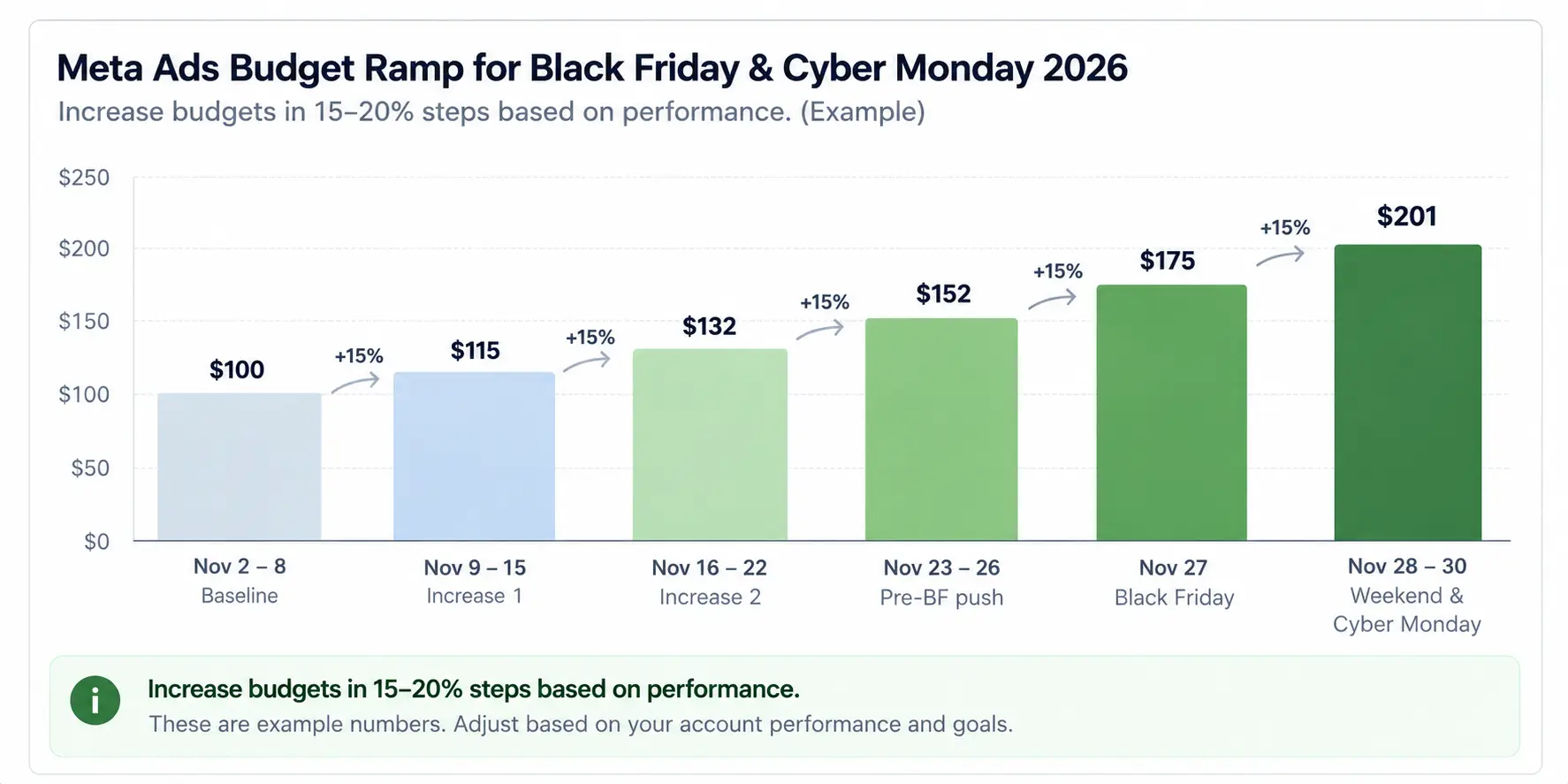
7. Ramp budget in small steps, not one leap
Starting roughly two weeks before Black Friday, increase budget in steps of 15 to 20% every few days rather than jumping straight to your peak spend. This is the same rule from scaling any Meta account, just compressed. Budget changes under that threshold are less likely to trigger a full learning phase reset, and a reset is the last thing you want heading into your highest-stakes week.
8. Set frequency and cost alerts before the sale, not during it
Set a frequency alert around 3 to 3.5 within a short rolling window, and a cost-per-result alert tied to your break-even number from step 3. Keep these as notifications only for now. You want eyes on them, not automatic pauses, until you’re past the peak days.
Want your Meta account ready before the rush?
I help eCommerce brands plan the ramp, lock the creative and protect ROAS through Q4, so peak spend doesn’t turn into peak waste.
Get a Free Meta Ads Audit →Black Friday week: the freeze list
9. Stop editing live ad sets
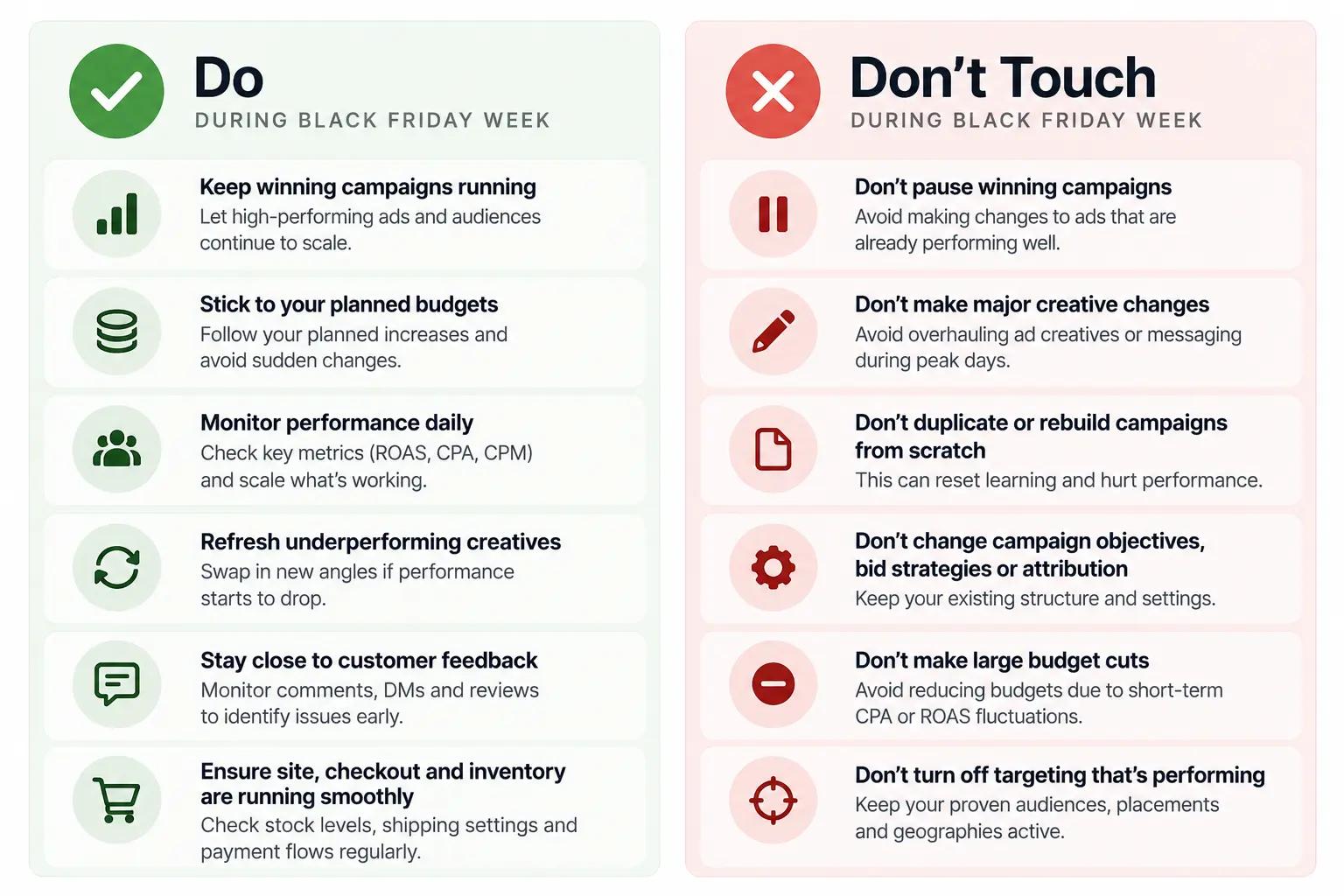
Once Black Friday week starts, don’t change targeting, bid strategy or optimization events on ad sets that are already running and stable. Each edit risks resetting learning at the exact moment you can least afford instability. If a new idea comes up, launch it as a new ad set instead of touching a live one.
10. Save your biggest budget jumps for the actual peak days
Hold your ramped, steady budget through the days leading in, then take the real jump, often two to three times your baseline, specifically on Black Friday and Cyber Monday. CPMs during the peak window typically spike sharply, sometimes 60 to 90% above a normal month, then fall back within about a week. Tripling your budget on the worst CPM day of the year buys you less reach than tripling it a week earlier would, so concentrate the increase where the sales volume actually justifies it.
11. Check blended MER at set times, not constantly
Pick two or three fixed check-in times during peak days (morning, midday and evening work well) rather than refreshing Ads Manager all day. Checking constantly leads to reactive decisions on noisy, short-term data. Pause ads only when a real pattern shows up, not from one slow hour.
After the peak (December)
12. Step budget back down and shift toward retargeting
Once the weekend rush passes, bring spend back down over the first week of December and shift more of it toward retargeting the people who browsed or added to cart but didn’t buy during the peak. This is also when it’s worth tagging your Black Friday first-time buyers as a segment, so you can track how many come back for a second purchase.
Leading indicators to watch (not just ROAS)
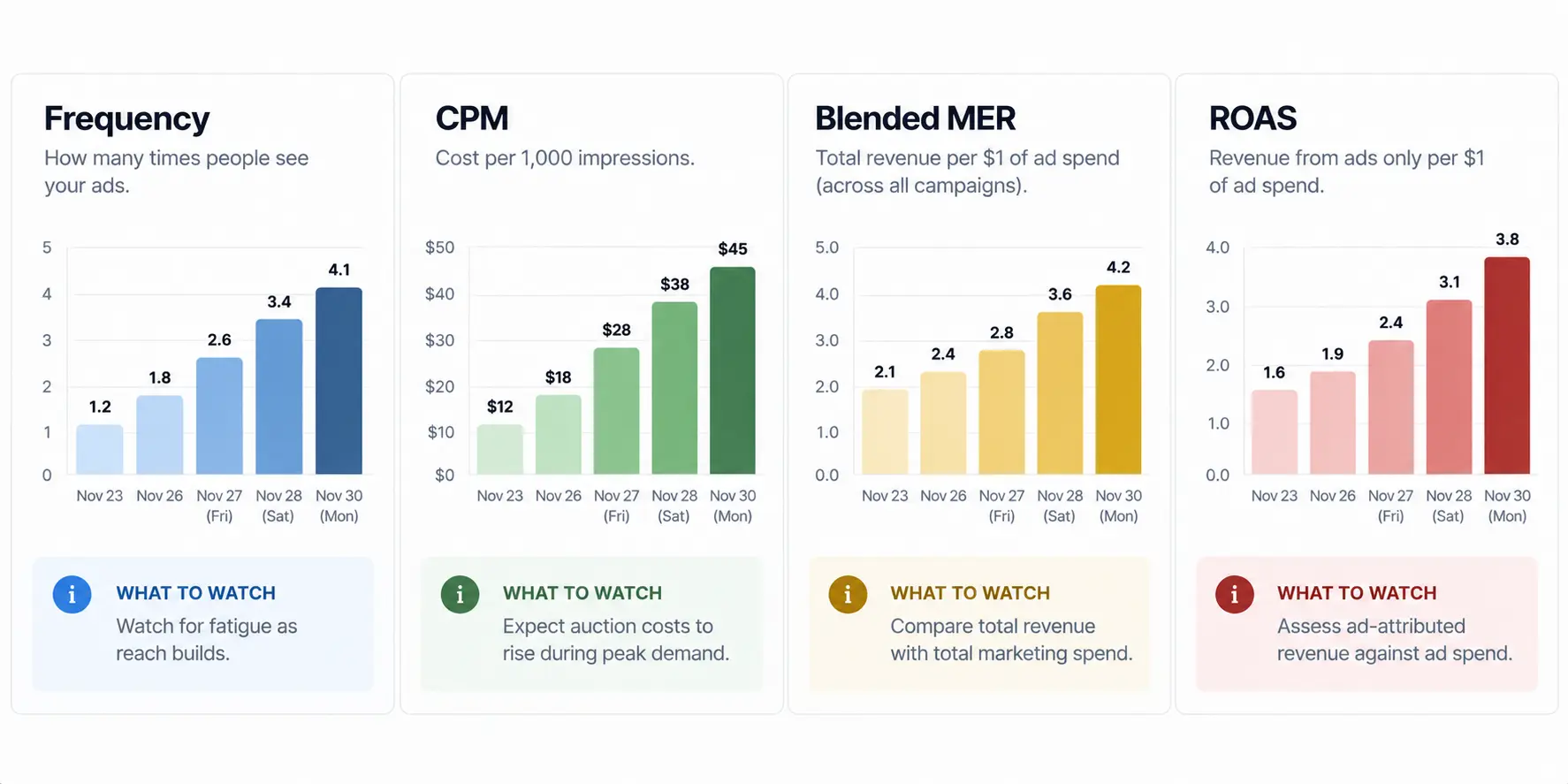
| Metric | What it tells you | When to act |
|---|---|---|
| Frequency | Repeat exposure during a short, high-spend window | Rising past 3 to 3.5 within 48 to 72 hours |
| CPM | How much the peak is actually costing you | A sharp spike around Black Friday and Cyber Monday is normal. Watch for it staying high a week later |
| Blended MER | True return across all channels, not just Meta’s reported number | Dropping below your break-even calculation from step 3 |
| ROAS | Platform-reported efficiency | Lagging. Check it, but decide from the three above first |
FAQ: Black Friday Meta ads
When should I start preparing Black Friday Meta ads campaigns?
Start pulling baseline numbers and consolidating ad sets in early November. Lock your offer and begin building creative by the second week of November, and aim to have everything tested and ready about two weeks before Black Friday itself.
How much should I increase my budget for Black Friday?
Ramp in small steps, 15 to 20% every few days, through the two weeks leading in, then take your largest jump, commonly two to three times baseline, specifically on Black Friday and Cyber Monday. Jumping straight to peak spend without the ramp risks a learning phase reset right when you need stability most.
Why do Meta CPMs spike so much during Black Friday?
Every advertiser increases budget in the same short window, so the auction gets more competitive across the board, not just for your account. The spike is usually sharp but short, often peaking right around Black Friday and Cyber Monday before falling back within about a week.
Should I pause underperforming ads during Black Friday week?
Be cautious. Frequent changes during peak days reset learning and add instability. Pause only on a clear, sustained pattern, not a single slow hour, and avoid editing targeting or bid strategy on ad sets that are otherwise stable.
What is blended MER and why does it matter more during Black Friday?
Blended MER is total revenue divided by total ad spend across every channel, not just what Meta’s dashboard reports. Meta tends to over-credit itself for conversions that other channels also touched, and during a high-spend week like Black Friday that gap matters more than usual.
What should I do after Black Friday ends?
Step budget back down over the first week of December and shift more toward retargeting people who engaged but didn’t buy. It’s also worth tagging first-time Black Friday buyers as a segment so you can measure how many return for a second purchase.
The bottom line
Black Friday doesn’t change how Meta’s delivery system works. It just compresses the normal scaling pressure into a few days and raises the stakes on every decision. The accounts that hold ROAS through it aren’t avoiding the CPM spike, because nobody does. They’re the ones who locked their numbers early, ramped on a schedule instead of jumping, and left their live campaigns alone during the week that matters most. Prepare in November, protect the account in the moment, and let December be when you actually collect on the work. For the full reasoning behind the ramp rule, see why ROAS drops when you scale Meta ads.
Want someone to run your Black Friday ramp with you?
I audit Meta ad accounts end to end and build a ramp, creative and alert plan around your offer and break-even return. No pitch, no commitment.
Book a Free Meta Ads Audit →Or message me directly on WhatsApp.
Sources and notes
- The CPM spike range, the 15 to 20% ramp rule, the frequency thresholds and the break-even increase in this checklist are general industry guidance and working rules of thumb, not figures from a single study. Results vary by account, category and offer, so test against your own baseline numbers.