
Your Google Ads might be hitting their targets. Your social content might be building real awareness. Your email flows might be generating consistent sales. Each one, looked at on its own, is doing its job.
The question most brands never ask is whether those jobs add up to anything together.
Here’s a scenario that plays out thousands of times a day: someone clicks a Google ad, lands on a product page, adds something to their cart, and leaves. If that’s where the relationship ends, the click was wasted, not because the ad failed, but because nothing picked up where it left off. Average documented cart abandonment sits around 70% across the studies tracked by the Baymard Institute, so this isn’t an edge case. It’s closer to the default outcome.
When channels are connected instead of isolated, that same visitor can get a retargeting ad that reinforces why the product is worth it, an email reminding them what’s sitting in their cart, and later, once they’ve bought, a follow-up sequence that nudges them toward a second order. Each channel still has its own job. The difference is that the jobs build on each other instead of starting over every time.
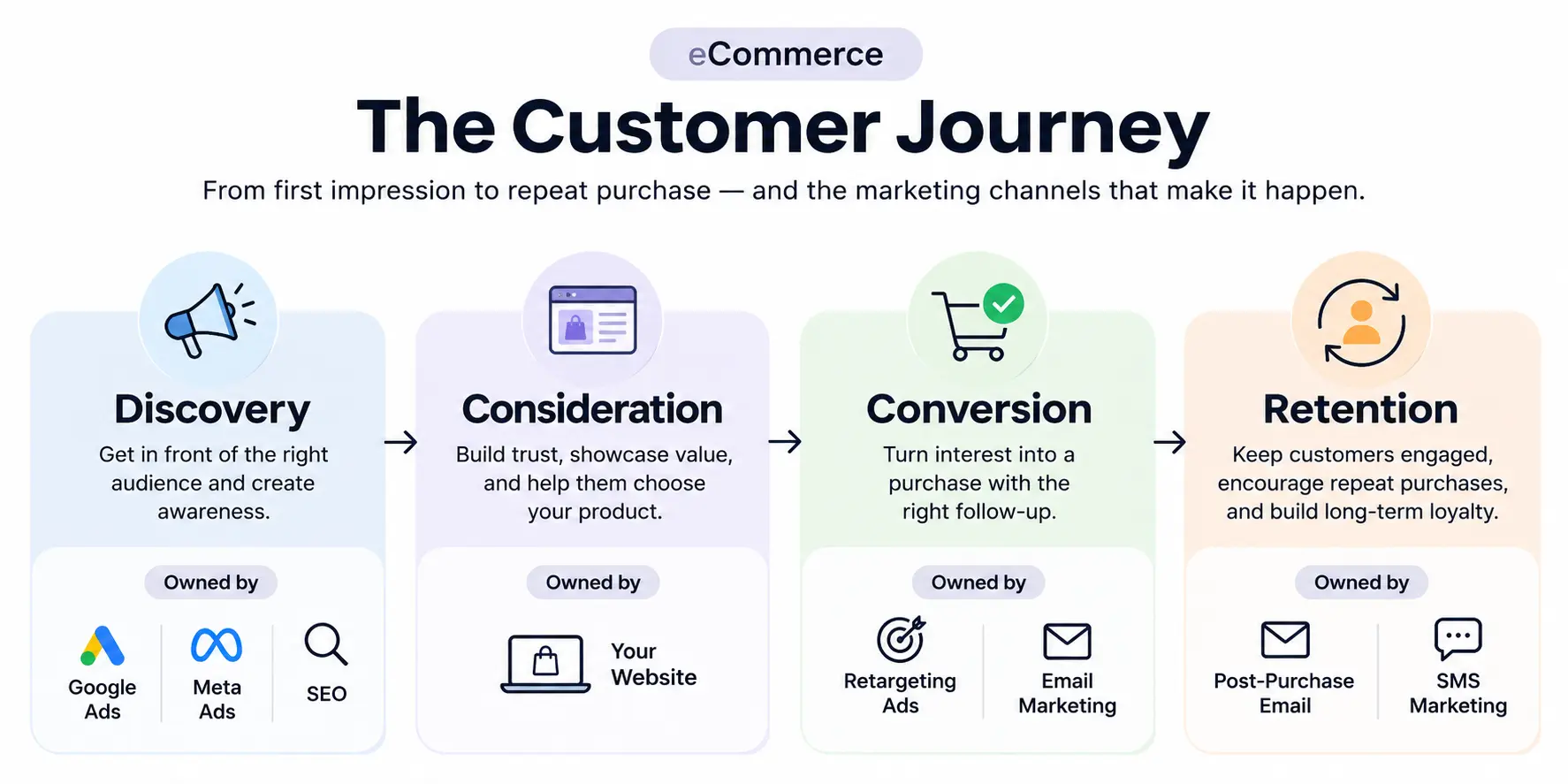
What is the eCommerce customer journey?
The ecommerce customer journey is the full path a shopper takes from first discovering a brand to becoming a repeat customer, usually moving through discovery, consideration, conversion and retention. Each stage tends to get handled by a different channel: Google Ads and social for discovery, your website for consideration, email and retargeting for conversion and retention. That’s exactly why the journey breaks down when those channels don’t share data or context with each other.
Why channels end up siloed in the first place
Channels end up siloed because different teams or tools optimize for their own number (cost per click, engagement, open rate) with nobody responsible for the customer’s path between them. The fix isn’t more tools, it’s assigning clear ownership of the handoffs between channels.
Most of the time it’s not a strategy decision, it’s an org chart problem. Paid ads, social and email often get run by different people, different agencies or different tools that don’t talk to each other. Each one optimizes for its own number: the ads team chases cost per click, the social team chases engagement, the email team chases open rate. Nobody’s job is to look at what happens to one person as they move between all three.
I’ve spent the last four-plus years running paid ads, social and email for eCommerce brands, and the accounts that frustrate me most aren’t the ones with weak creative or bad targeting. They’re the ones where three separate tools are collecting data on the same customer and none of them are talking to each other.
The result is a customer who experiences your brand as several disconnected conversations instead of one. They see an ad that doesn’t match the email they got last week. They get a “come back and save 10%” email after they already bought, because the email platform never found out the purchase happened on a different device. None of these are big failures individually. Added up, they make the brand feel less trustworthy, even when every channel is technically performing well on its own metrics.
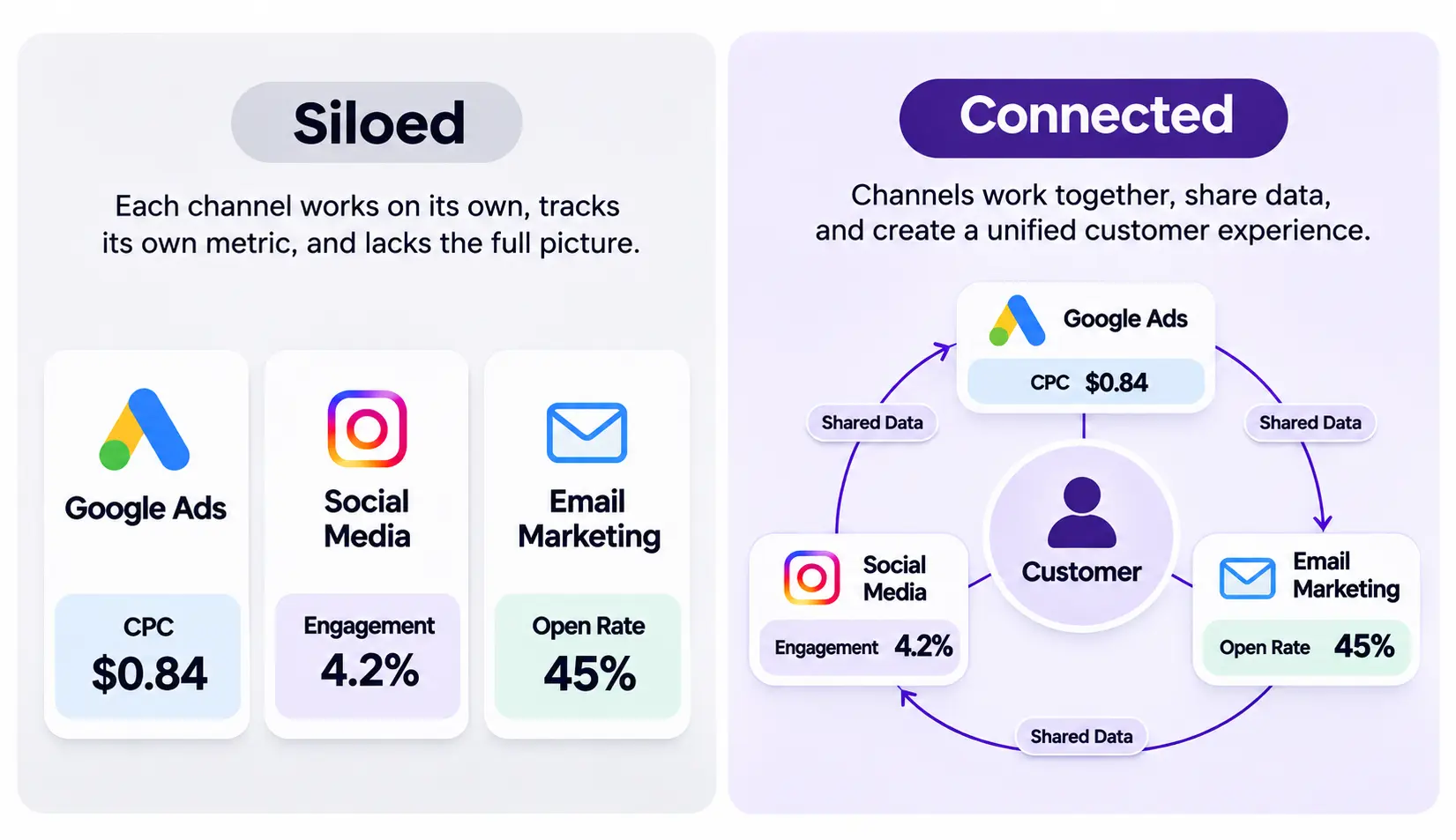
How the journey actually works, channel by channel
It helps to think in four stages rather than trying to map every possible path a customer could take.
Discovery
This is where Google Ads, Meta Ads, organic social and SEO content do the heavy lifting. Someone who doesn’t know your brand yet encounters it through a search result, a feed ad or a piece of content that answers a question they had. The job here is narrow: earn enough interest that they’re willing to look closer. Trying to sell hard at this stage usually backfires, because the person hasn’t decided they have a problem worth solving yet.
Consideration
The visitor is now comparing. They’re reading product pages, checking reviews, maybe opening a few competitor tabs alongside yours. This is where website experience matters more than any ad ever could: clear pricing, visible shipping and return information, and real social proof. If someone arrives at this stage from a Google ad promising a specific thing, the landing page needs to deliver on that specific thing immediately, not three clicks later.
Conversion (and the drop-off that follows)
Most visitors leave here without buying. This is the moment where connected marketing actually pays off, because it’s also the moment siloed marketing goes quiet. A retargeting ad can remind them what they looked at. An abandoned cart email, sent to people who’ve given consent to receive one, can do more directly. Klaviyo’s 2024 benchmark report, based on over 143,000 abandoned cart flows from 2023, found an average 3.33% placed-order rate from cart recovery emails, with the top 10% of brands converting at 7.69%. That’s not a guess about what might work, it’s a measurable channel doing a specific job that ads alone can’t do once someone has left your site.
If you want to see how to build these automations, start with the five flows every eCommerce brand needs.
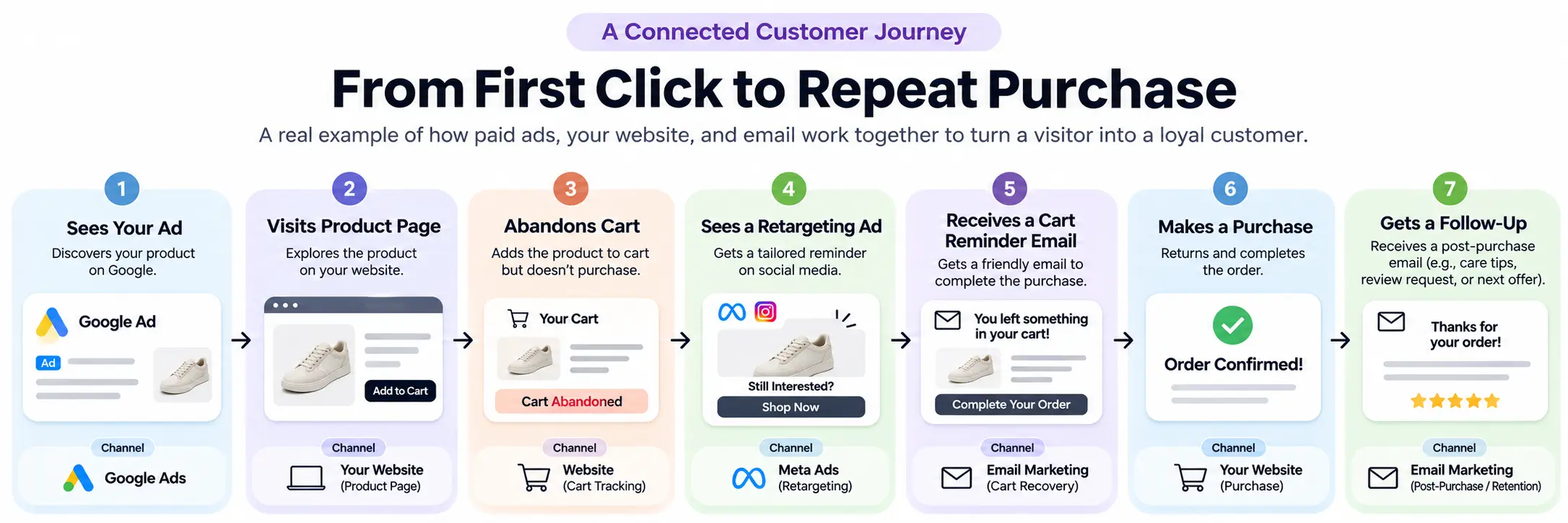
Retention and repeat purchase
The sale isn’t the end of the journey. It’s usually the point where the most overlooked channel takes over: post-purchase email and SMS. Order confirmations, delivery updates and well-timed follow-up offers are what turn a one-time buyer into a repeat one. This stage gets the least attention from most brands because there’s no urgency to it the way an abandoned cart does, but it’s often the cheapest revenue available, since you’re not paying to reach a new audience.
This is also where customer lifetime value (CLV) becomes the more honest scorecard than any single campaign’s ROAS, since a customer who buys three times at a lower acquisition cost is often worth more than one expensive, one-time conversion.
Not sure how your channels connect for an actual customer?
I map the journey across ads, email and tracking for eCommerce brands, so every channel picks up where the last one left off.
Book a Free Strategy Call →Reconnecting with visitors who leave
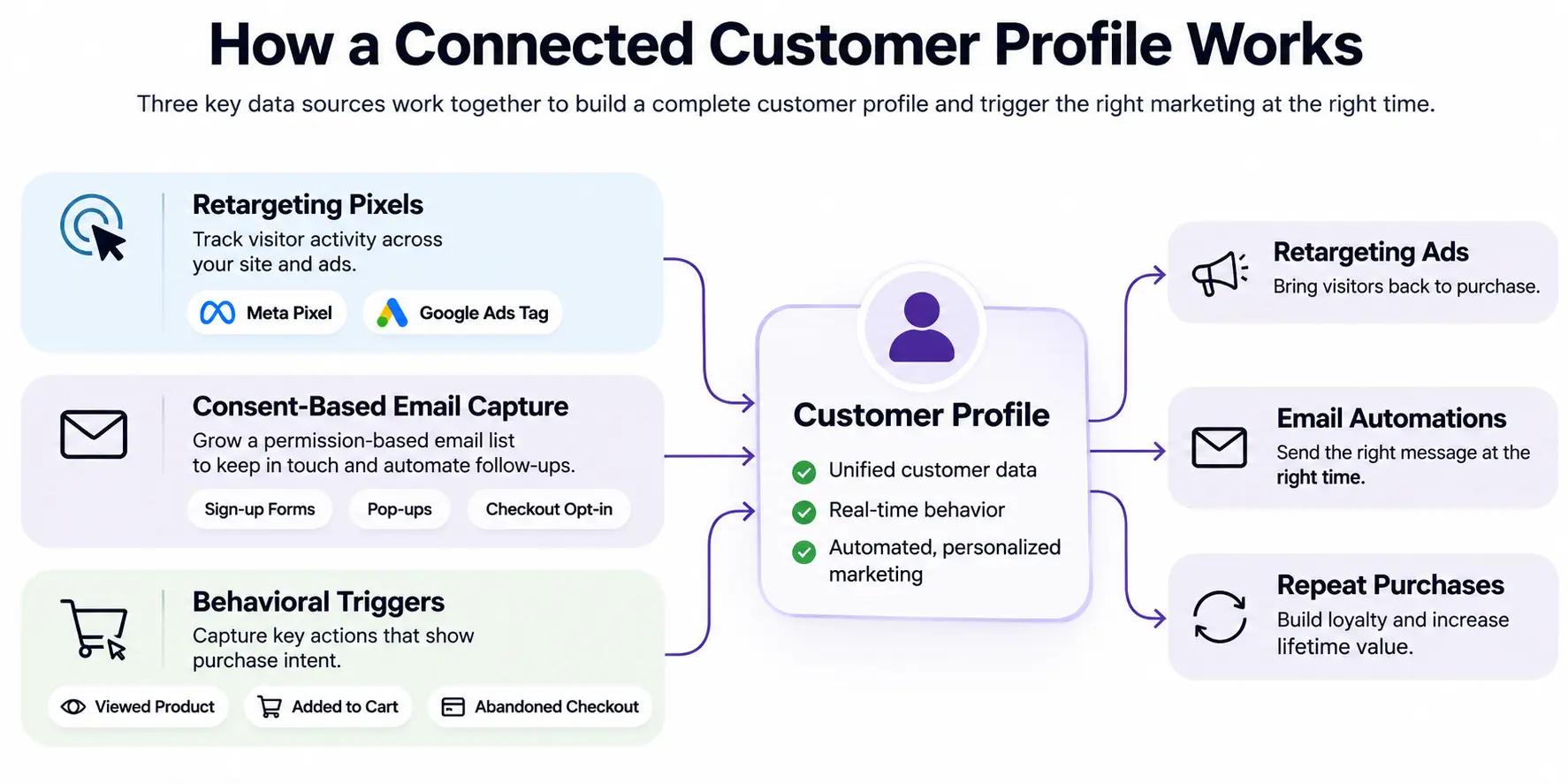
Reconnect with visitors who leave using three mechanics together: retargeting pixels, consent-based email capture and behavior-triggered messaging. None of these require exotic tools. Shopify, a standard ad pixel and an email platform like Klaviyo cover most of what a mid-sized eCommerce brand needs.
That usually comes down to three mechanics working together:
Retargeting pixels (Meta Pixel, Google Ads tag) that let you show a follow-up ad to people who visited specific pages, rather than a generic audience.
Email capture with proper consent, so that if someone has given you their email, whether through account creation, a newsletter signup or checkout, you can follow up directly rather than relying only on them seeing an ad.
Behavioral triggers, where the action someone took (viewed a product, added to cart, abandoned checkout) determines what they see next, instead of every visitor getting the same generic message regardless of where they dropped off.
This is roughly the stack I work in day to day: Shopify on the backend, Klaviyo for email, Meta and Google pixels feeding both. None of it is exotic. What actually separates a connected account from a siloed one isn’t the tools, it’s whether someone’s job is to make sure those tools reference each other.
What this looks like in practice
In general terms, the brands that get this right tend to follow a consistent pattern: they map out where a customer could realistically drop off at each stage, decide which channel is responsible for catching them at that point, and check that the message in that follow-up actually references what the person did, not a generic “we miss you.”
A Google ad that promised free shipping should lead to a landing page that shows free shipping, not a vague homepage. A retargeting ad for an abandoned product should show that product, not an unrelated bestseller. A post-purchase email sequence should account for what someone actually bought, so a one-time consumable buyer gets a replenishment reminder instead of an offer for something they already own. These aren’t advanced tactics. They’re the difference between a channel doing its job in isolation and a channel doing its job as part of something bigger.
Measuring whether it’s actually working
Channel-specific metrics (ROAS on Meta, CPC on Google, open rate on email) tell you whether each piece is healthy on its own. They don’t tell you whether the pieces are working together. A few measurements fill that gap:
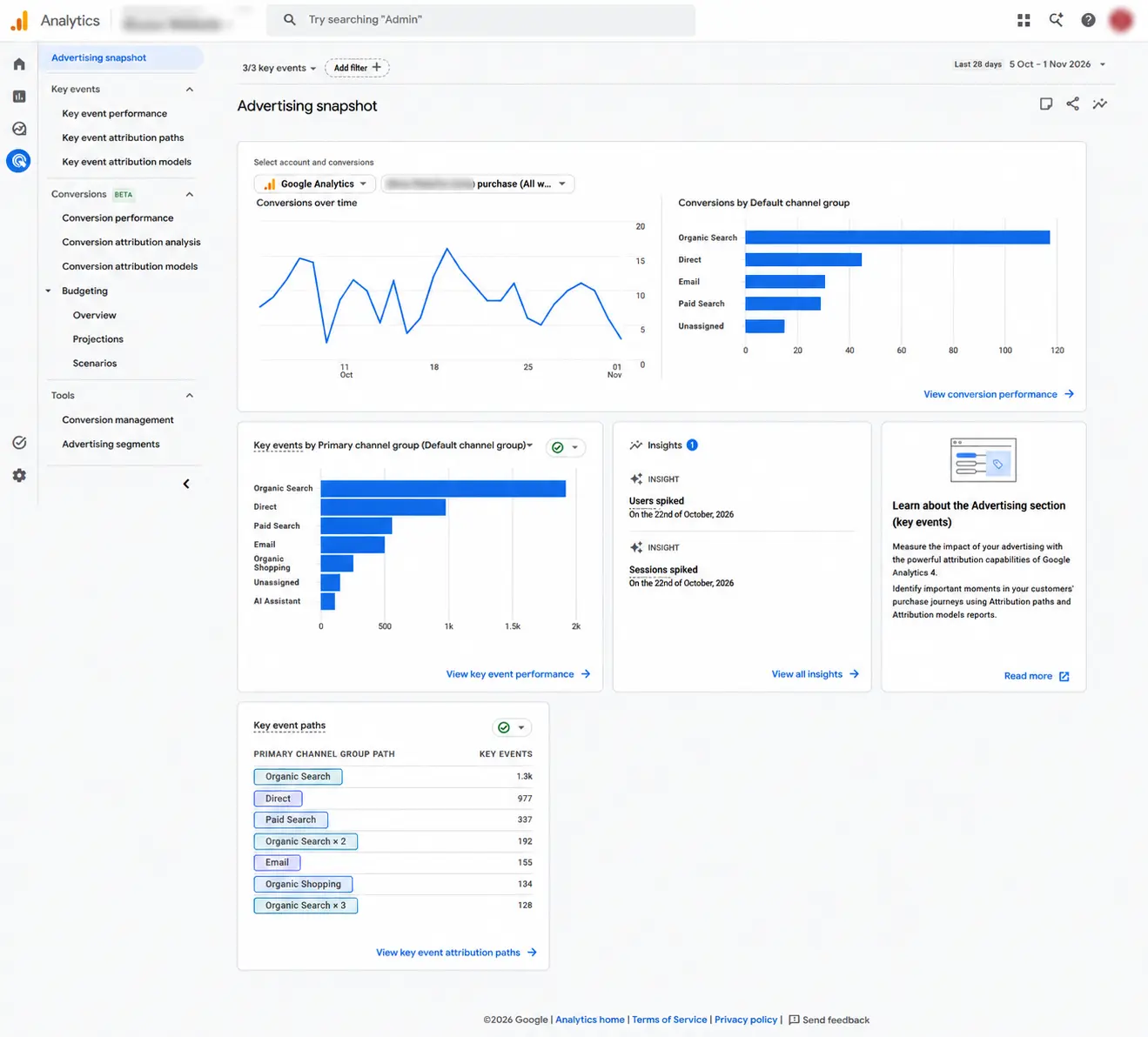
Assisted conversions, available in GA4’s attribution reporting, show which channels contributed to a sale even when they weren’t the last click. This is usually the first thing that reveals a channel is doing more work than its last-click numbers suggest.
Blended return, total revenue divided by total marketing spend across every channel, rather than each platform’s self-reported number. Ad platforms tend to over-credit themselves for conversions other channels also touched, so this is a useful check against inflated individual-channel numbers. The same effect shows up as budgets grow, which I break down in why ROAS can be misleading once you’re scaling spend.
Time to repeat purchase, tracked by customer segment, shows whether your retention efforts are actually shortening the gap between a customer’s first and second order, which is a more honest measure of a connected journey than any single campaign’s performance.
None of these replace channel-level reporting. They sit on top of it, answering a different question: not “did this ad work,” but “did this customer’s experience across every channel add up to something coherent.”
Common mistakes and where this breaks down
A few patterns come up repeatedly in accounts that look connected on paper but aren’t in practice. They get worse under peak-season pressure, and I walk through the mistakes that show up most during Black Friday week in my Black Friday Meta ads checklist.
Treating consent as an afterthought. Email and SMS follow-up only works, legally and practically, when someone has actually opted in. An abandoned cart email sent without proper consent isn’t a growth tactic, it’s a compliance problem waiting to surface.
Over-personalizing past what the data supports. Referencing specific behavior works when it’s accurate. Getting it wrong (recommending something someone already bought, or a size that doesn’t match their order history) does more damage to trust than a generic message would have.
Centralizing data without anyone using it. A CRM or customer data platform that nobody actually checks before building a campaign isn’t integration, it’s just a database. The tooling matters less than whether someone is responsible for using what it shows.
Treating this as a one-time project. Customer behavior shifts, new channels emerge, and a journey map built a year ago stops reflecting how people actually move through your brand. This needs periodic review, not a single setup phase.
The bottom line
None of the individual pieces here are new. Retargeting, email automation and journey mapping have existed for years. What’s still rare is treating them as parts of one system instead of separate line items, each reporting to a different goal. The goal was never to be everywhere. It’s to make sure every relevant interaction a customer has builds on the one before it, so that by the time they’re deciding whether to buy again, your brand feels like it’s been paying attention the whole time.
If your channels are currently reporting good individual numbers but you’re not sure how they connect for an actual customer, that disconnect is usually the first thing worth mapping out before adding more spend to any single one of them.
Want me to map your customer journey?
I look at your ads, email flows and tracking together, find where customers drop out, and show you which channel should catch them. No pitch, no commitment.
Book a Free Strategy Call →Or message me directly on WhatsApp.
FAQ: the eCommerce customer journey
What’s the difference between multichannel and omnichannel marketing?
Multichannel marketing means being present on several channels that often operate independently. Omnichannel marketing means those channels are connected, sharing customer data and context so the experience feels consistent whether someone is on your site, in their inbox or looking at a retargeting ad.
Do I need an abandoned cart email if I’m already running retargeting ads?
They do different jobs rather than duplicating each other. Retargeting reaches people broadly based on behavior, while an abandoned cart email (sent with proper consent) can speak directly to what someone left in their cart. Klaviyo’s benchmark data shows cart recovery emails converting at a measurable rate on their own, so the two channels tend to work better together than either does alone.
How do I know if my marketing channels are actually connected or just running in parallel?
A practical test: pick a recent customer and trace what they would have seen at each stage, the ad, the landing page, any retargeting, any email. If the messaging references what they actually did, the channels are connected. If every touchpoint feels generic regardless of their behavior, they’re running in parallel.
Sources
- Baymard Institute, Cart Abandonment Rate Statistics (aggregated average, about 70%)
- Klaviyo, 2024 Benchmark Report (abandoned cart flow conversion data, based on 143,000+ flows from 2023)
- IBM, What is omnichannel customer experience (further reading)